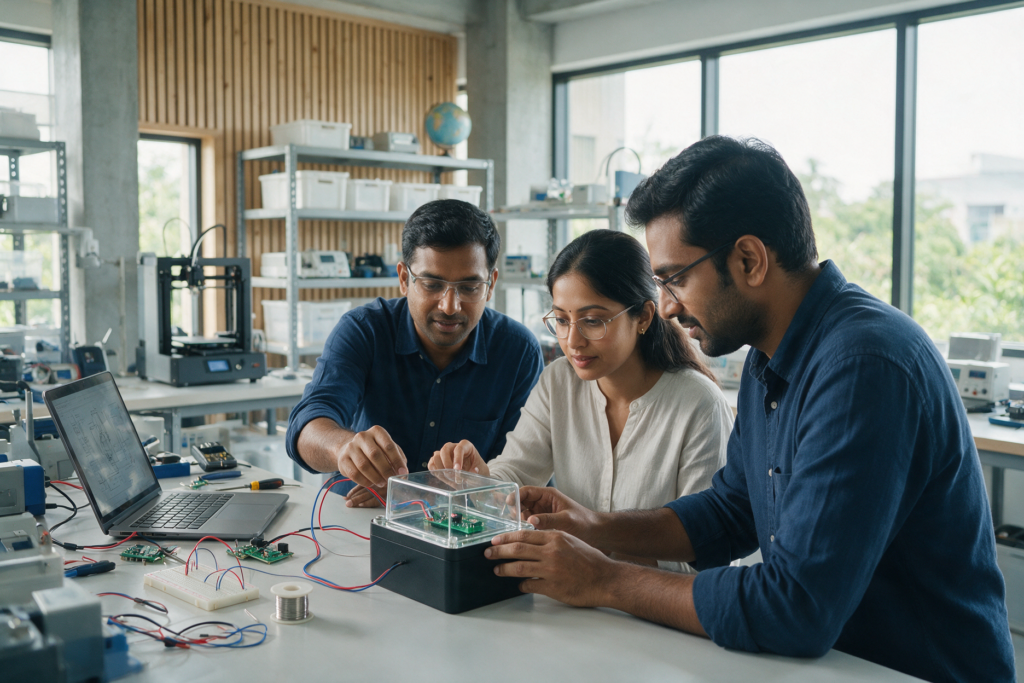
Invention and prior-art review
Organise the technical features and identify relevant existing publications before preparing a filing strategy.

PATENT APPLICATION SUPPORT IN INDIA
Describe the issueand your solution.
Gather inventorand filing records.
UNDERSTAND YOUR FILING
A useful patent discussion starts with the technical problem, your proposed solution and the work already available in the field. Bring those elements together before deciding how to file. We help organise the information needed for a patent application and identify the drafting, filing and follow-up work your case requires.
PLAN THE RIGHT SUPPORT
Organise the technical features and identify relevant existing publications before preparing a filing strategy.
Discuss whether the available disclosure supports a provisional filing and what further work is needed.
Prepare the technical description, claims and drawings for the proposed filing scope.
Review Patent Office communications and confirm the scope of any response or hearing work separately.
Describe the problem and solution in a structured way.
Bring inventor, applicant and technical records together.
Separate filing, publication, examination and grant.
The right route depends on the applicant, subject matter and existing records.
The invention must satisfy novelty, inventive step and industrial applicability, and avoid statutory exclusions.
Identify the inventor and the applicant’s right to seek protection.
Review demonstrations, sales, publications and earlier applications before choosing a filing route.
Share relevant earlier filings and disclosures at the outset so the requirements can be assessed for your case.
Start with your objective and the work already completed.
This is a starting checklist. The final documents depend on your filing route. Use the enquiry form for a high-level summary rather than confidential technical material.
Understand the technical contribution and available records.
Stage 1
Assess the information, prior art and appropriate application route.
Stage 2
Coordinate the specification, drawings and formal particulars.
Stage 3
Keep the acknowledgement and identify the applicable next actions.
Stage 4
Review official objections and plan responses within applicable deadlines.
Stage 5
Preparation depends on the quality and completeness of the technical disclosure.
Applications are ordinarily published after 18 months from filing or priority, whichever is earlier, subject to exceptions and early-publication provisions.
A timely examination request and responses are separate requirements. The Patent Office decides grant; no grant date is guaranteed.
MAKE AN INFORMED CHOICE
| Question | Provisional specification | Complete specification |
|---|---|---|
| Primary role | Records the invention disclosed at that stage. | Sets out the complete disclosure and claims. |
| Preparation focus | Sufficient technical detail for the material being disclosed. | Detailed description, claims and supporting material. |
| Next action | A complete specification must follow within the applicable deadline. | Plan publication, examination and prosecution requirements. |
A provisional filing is not a granted patent. Confirm deadlines and disclosure sufficiency for your specific case.
WHY TRADE INNOVATION
Bring your objective and available records. We’ll help organise the application discussion around your circumstances.
Identify the information your chosen route needs.
Understand the preparation, filing and follow-up work included.
Keep the documents and next actions organised.
CLIENT EXPERIENCES
Preview content: cards marked “Design sample” use fictional names, feedback, ratings and dates.
VIDEO GUIDES
EXPLORE RELATED IP SUPPORT

Explore the PCT route with support for priority records, international application preparation and planning the national or regional stages that follow.
Explore service

Prepare an Indian design registration application around the visual features of your product, with support for representations, ownership details and filing requirements.
Explore service

Get help organising your work, ownership documents and copyright application—with a filing approach suited to what you have created.
Explore serviceNo. Patentability depends on the claimed technical subject matter and statutory requirements. An idea alone is not enough to assume eligibility.
Yes. Prior disclosure can affect patentability. Start with a high-level enquiry and arrange a suitable way to share confidential technical material.
No. Filing, publication, examination and grant are distinct stages.
A request for examination is required within the applicable time limit. Filing dates and transitional rules must be checked for the particular application.
The quote depends on the applicant category, technical complexity, drafting scope and filing stages. Government fees and professional work should be identified separately.